For a long time, outsourcing was purely driven by cost reduction. Countries like India quickly became the gold standard; vast levels of talent and competitive rates. That benchmark built the offshore industry as we know it. And it certainly worked, but now something has since shifted.
In 2024, Deloitte’s Global Outsourcing Survey found that, for the first time since the pandemic, access to talent overtook cost reduction as the #1 outsourcing driver. Now, only 34% of companies rank cost saving as their primary goal, down from 70% in 2020.
That’s why Latin America isn't just a trend anymore, it is an established strategic decision. As the rise of LATAM as a nearshore destination rapidly increases, one question arises: when you compare LATAM nearshoring to offshoring side by side, which model actually delivers the most value?
The collaboration gap
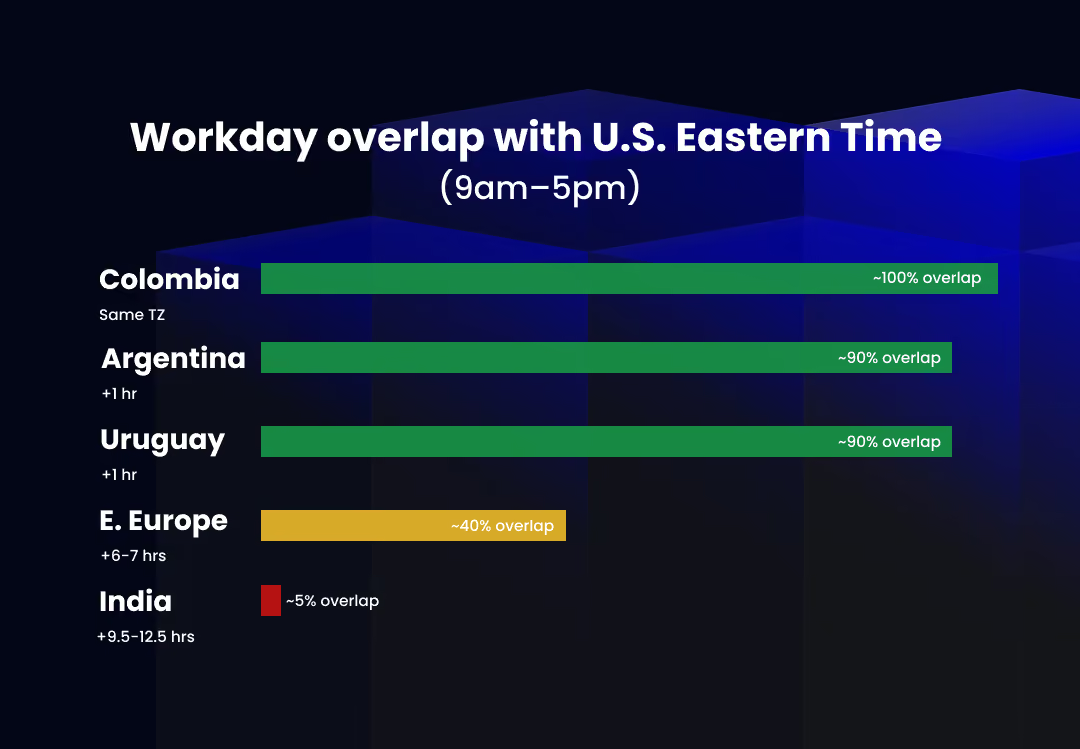
Countries like India are up to 12.5 hours ahead of U.S. business hours. That means close to zero natural workday overlap. For Indian teams working for the U.S., overnight shifts are par for the week. For back-office work this routine is manageable, but for real-time judgement, fast feedback or collaborative decision making, it is a structural limitation.
A Working Paper from Harvard Business School (2021) confirms real-time communication drops 11% for every additional hour of time zone difference. LATAM, on the other hand, shares 85-100% of the U.S. working hours.
It’s not about cost, it’s about talent
Currently, it is a widely believed myth that nearshoring to LATAM is a strategy worth only to fill entry-level roles on a budget. However, it is estimated that over 80% of hires in 2025 were mid-level or senior professionals.
U.S. companies are not hiring from LATAM because they cannot afford quality; they are hiring here because they can now afford the quality they couldn’t access domestically.
Our honest take
Although South Asia key markets remain as destinations with formidable, huge talent pools, the world has moved on from that single-axis decision.
For businesses running large-scale, mechanical operations where cost reduction is the primary objective, those markets are still a strong model. But when collaboration, cultural fit and real-time responsiveness are on the table, Latin America outperforms.
The numbers are increasingly bearing this out.
It isn’t a trend, it's a structural shift.